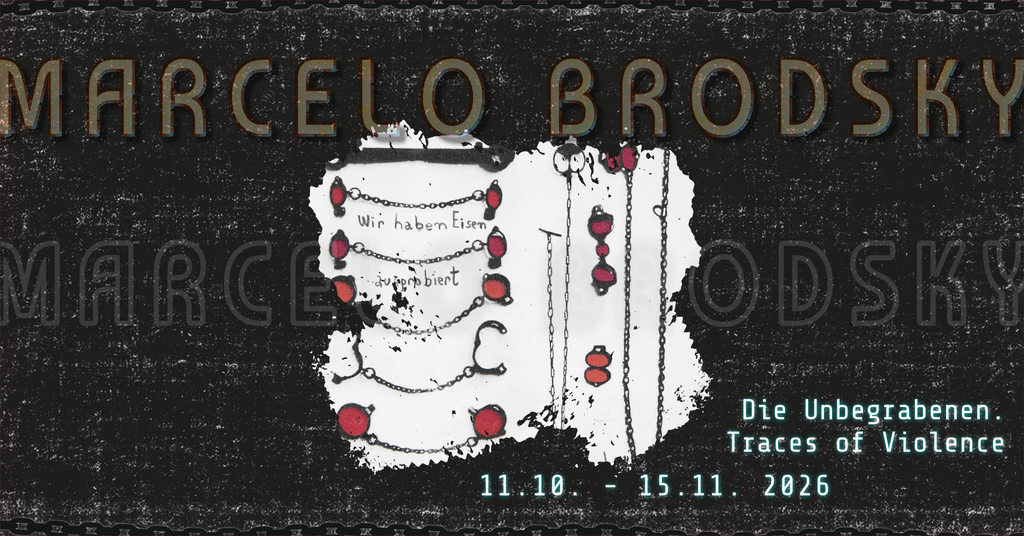
An exhibition by Marcelo Brodsky, featuring works by Forensis and Forensic Architecture
Opening hours: Thu–Sat, 3:00–6:00 p.m. and by appointment
Opening reception: Sun., October 11, 10 a.m.–1 p.m.; 12 p.m. talk with the artist and the curator
Closing event: Sun., November 15, 4:00 p.m.
The exhibition is curated by Prof. Dr. Márcio Seligmann-Silva
Between 1904 and 1908, in what was then German South-West Africa, the German colonial army waged a war of extermination against the Ovaherero and Nama peoples. Thousands of survivors were deported to concentration camps, where forced labor, starvation, disease, and systematic violence killed thousands more. Shark Island, off the coast of Lüderitz, became a death camp – the first of the twentieth century. The bodies of those who died there were denied a dignified burial. Shark Island remains after more than a century a contested site of memory and is now threatened by large-scale “green hydrogen” infrastructure projects, which is being promoted with the support of the German government.
At the heart of the exhibition is Marcelo Brodsky’s series Traces of Violence (2021), which consists of thirty historical photographs altered with crayon and text by the artist. Brodsky himself is a descendant of Jewish exiles who fled to Argentina to escape anti-semitic persecution in Tsarist Russia. His work emerged from the traumas of political exile during the Argentine dictatorship.
Texts and a video by Forensic Architecture and Forensis, produced in collaboration with the Ovaherero Traditional Authority (OTA) and the Nama Traditional Leaders Association (NTLA), reconstruct the history and geography of the concentration camp.
A series of talks, discussions, screenings, and guided tours will accompany the exhibition, exploring the historical continuities between colonialism, militarism, fascism, memory, and contemporary struggles for justice.
„Die Unbegrabenen. Traces of Violence“ at roam projects will close on November 15, the anniversary of the opening of the Congo Conference in Berlin in 1884, whose Final Act established the framework for the partition of Africa into European colonies.
Graphic design: Stephan Weißer











![Schools of Hope Kinderträume – Zukunftsräume [Children’s Dreams – Future Spaces]](https://www.roam-projects.eu/wp-content/uploads/2024/10/banner_1-e1738854065552.jpg)