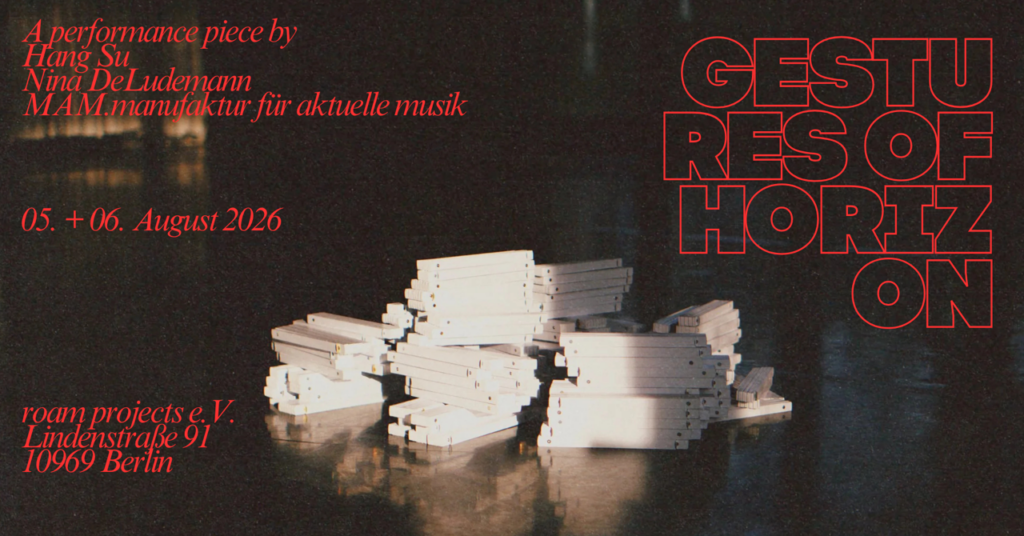
GESTURES OF HORIZON
Performative sound installation, inspired by Maria Reiche’s research practice
Dates
Free admission at any time during opening hours:
5 August 2026:
5 pm until sunset (8:52 pm)
6 August 2026:
5:35 am sunrise walk (1 hour) starting and ending at the venue
Exhibition open until sunset (8:48 pm)
GESTURES OF HORIZON is a sound installation inspired by the life and work of German mathematician, physicist, and researcher Maria Reiche (1903–1998), who dedicated her life to exploring and preserving the Nazca Lines in Peru.
In this work, Hang Su (composition), Nina DeLudemann (scenography), and musicians from the Ensemble MAM.manufaktur für aktuelle musik explore how Maria Reiche’s research resonates in the present. Today, mountains of discarded textiles are piling up in the desert that was once engraved with ancient drawings. GESTURES OF HORIZON invites viewers to shift their perspectives and reassess the scope of human actions.
On a stage made of sandpaper, the performers play instruments created especially for the event. The audience is invited to imagine the vastness of the Peruvian desert and, through the intimacy of sound, experience how it relates to their own lived experience. Four hundred and eighty-six metres of white folding rulers mark the difference in elevation between Berlin and Nazca. The performers shape them into various structures that sometimes resemble the desert geoglyphs, and at other times the mountains of used clothing that industrialized nations dump in South American deserts today. The costumes and blankets on which visitors can sit within the installation are also made from these recycled textile mountains.
The installation blurs fixed categories of what is here and now and opens up possibilities for collectively observing what is absent and what has passed. Photographs, notes, and drawings from Reiche’s estate were translated into sound, movement, and spatial structures in the installation.
As a woman in Germany in the 1930s, Maria Reiche did not see a chance to pursue her dreams. When she saw a chance to move away, she emigrated to Peru. There, too, as a woman and an outsider, she repeatedly encountered closed doors. However, this did not prevent her from standing up for the people and landscapes with whom she lived and wanted to share space. Until her death, she used her research to advocate for the significance of the desert drawings and, in doing so, for the preservation of Indigenous cultures threatened by commercial interests.
The performance brings to life the physical dimension of her research: surveying landscapes on foot, drawing lines, and repeatedly cleaning and uncovering markings that are thousands of years old. These gestures give rise to a living archive that connects the past and the present.
At the same time, the production turns its attention to current global interconnections. The question of how landscapes are shaped by human activity links the view of the Nazca Desert today with Maria Reiche’s observations.
More information and programme updates:
https://www.manufaktur-aktuelle-musik.de/projects/gestures-of-horizon
Concept & Artistic Direction
Hang Su (Composition)
Nina DeLudemann (Scenography)
Katja Cheraneva (Movement Coach)
By and with
MAM.manufaktur für aktuelle musik
Paul Hübner
Sabrina Ma
Caleb Salgado
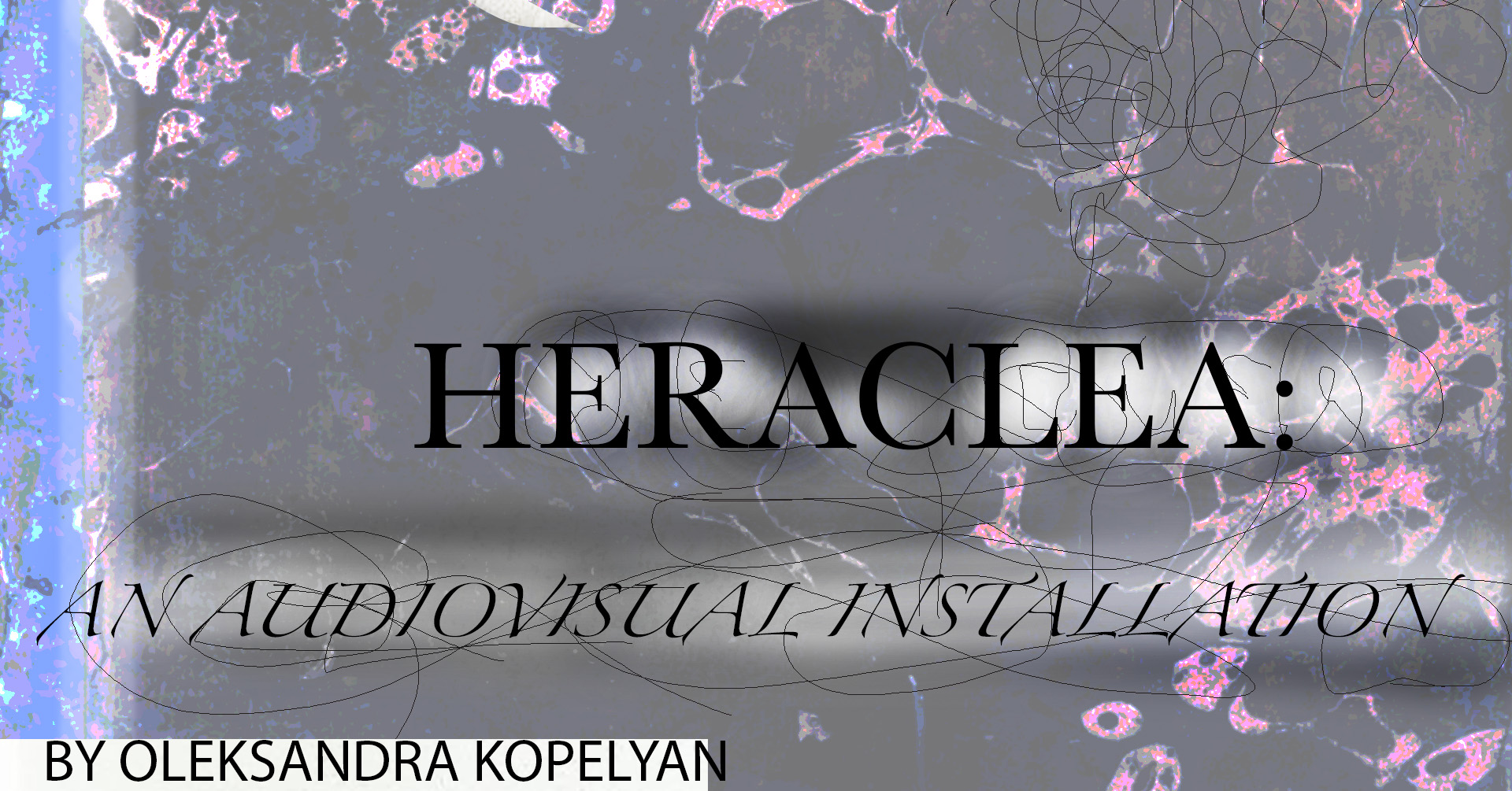
Graphic design © Hang Su, 2023
The production was developed in Berlin in 2022–2023 and supported by the Fonds Darstellende Künste with funds from the Federal Government Commissioner for Culture and the Media. The premiere took place in 2023 at the Museum of Fine Arts in Leipzig.
The Solemnity of the Repulsive
13–27 August 2026
Vernissage: 13 August, 7–9:30 pm
Opening hours: Thu–Fri 4–7 pm, Sat 2–5 pm + by appointment
Finissage: 27 August, 6–9 pm
The exhibition brings together artists Dariia Maiier and Sofiia Yesakova, creating a space where distinct aesthetic languages encounter shared sensibilities and experiences. Both currently based in Germany, Dariia and Sofiia studied in Mykola Storozhenko’s studio at the National Academy of Visual Arts and Architecture in Kyiv, which focused on monumental art, religious postmodernism, and an aesthetic rooted in the Northern Renaissance and Ukrainian Baroque.
Although both artists have moved beyond academicism, this background continues to echo in their attentiveness to detail and laborious production processes. The exalted character of this artistic legacy is also reflected in the theme the artists explore in the present exhibition: The Solemnity of the Repulsive.
In Yesakova’s works from the series Ugly Scenes. Nuances., the objects, in their minimalist forms, black colour, and compositions, are reminiscent of ceremonial elements, exuding dignity and even a sense of the sacred. This sombre appearance, however, is layered upon the pulsating materiality of wood, hinting at the underlying reality of extreme and repulsive violence. The artist finds inspiration in Hans Schwarz’s Death and the Maiden (1520), where the viewer encounters a similar juxtaposition on a natural wooden panel. Likewise, the image is difficult to discern, requiring the viewer to move around the object in search of the right distance and angle.
Maiier presents two works connected by the figure of the horse as a subject of discipline and status. In Double Bridle. Weymouth Bit, she depicts a tool for controlling a horse, designed through pain to force the animal into unnatural poses and movements. The many depictions intended to showcase the beauty and elegance of dressage often serve as evidence of the animal’s stress. As in Yesakova’s work, animality pulsates beneath the animal parts that have come to be perceived as symbols of status. In Zadorny, Maiier explores the pedigree of the racehorse and the rider, a relationship that never seems to overcome its ties to militarism, both in symbolism and in practice.
In The Solemnity of the Repulsive, the artists explore the process of symbolic exaltation—in war, religion, sport, and status—through the dignified, heroic, and solemn imaginary of primitive and repulsive violence, otherwise unbearable to witness. Here, the pain, torture, or even death of an animal, a soldier, or a martyr becomes a resource of power, generating ideological references and integrating what would otherwise remain too abject to speak of into the cultural sphere and its heritage.







![Schools of Hope Kinderträume – Zukunftsräume [Children’s Dreams – Future Spaces]](https://www.roam-projects.eu/wp-content/uploads/2024/10/banner_1-e1738854065552.jpg)